

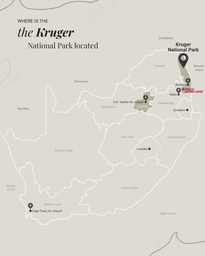
Kruger National Park lies in the north-eastern corner of South Africa, spanning two of the country’s nine provinces: Mpumalanga and Limpopo. It borders Mozambique to the east and reaches Zimbabwe at its northernmost point.
The Park extends approximately 350 kilometres (217 miles) from north to south and protects nearly two million hectares of the South African Lowveld, a warm, low-lying region in north-eastern South Africa. To put its extraordinary scale into perspective, Kruger National Park is almost the same size as Slovenia.
The Kruger is a landscape shaped by the wild
Kruger National Park is one of Africa’s most celebrated wildlife destinations, but its magic reaches far beyond the famous Big Five.
The Kruger Park is home to 147 mammal species, 507 bird species, 114 reptile species, 49 fish species, 34 amphibian species and 336 tree species. Elephants disappear into woodland, lion cubs tumble through the grass and kingfishers bring flashes of colour to quiet waterways.
Although Kruger National Park lies within the savanna biome, its landscape changes significantly from north to south. North of the Olifants River, mopane veld dominates, while the far north is known for baobabs, riverine forests and exceptional birdlife. South of the Olifants, thornveld, marula trees, granite outcrops and open grasslands create a different landscape and excellent opportunities for wildlife viewing.
How did Kruger National Park begin?
Although Kruger’s history is far more intricate and fascinating, its conservation story began in 1898, when land between the Sabie and Crocodile rivers was protected from uncontrolled hunting and the trade in ivory, skins and horns. The reserve was re-established in 1902, with James Stevenson-Hamilton appointed as its first warden. It later joined with the Shingwedzi reserve to formally become Kruger National Park in 1926.
The land’s history reaches back much further. Archaeological sites, ancient trade routes, rock art and cultural landscapes preserve traces of the people who lived and travelled through this part of the Lowveld long before the Park existed. Today, Kruger National Park is managed by SANParks (South African National Parks), a government-owned entity entrusted with protecting the Park’s natural and cultural heritage.
What makes Kruger National Park so special?
South Africa’s national parks each protect something remarkable, from mountains and coastlines to deserts and wetlands. Kruger’s distinction lies in the sheer scale and diversity of its safari experience.
Guests can explore designated roads in their own vehicles, join guided game drives or stay inside the Park and wake to the sounds of the bush. Sightings are never guaranteed and that is precisely the point. These are wild animals moving through a vast natural environment, not a landscape arranged for an audience.

Where is Mdluli Safari Lodge located in the Kruger National Park?
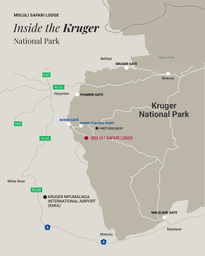
As one of a small number of private lodges situated within Kruger National Park, Mdluli Safari Lodge lies in the south-western region, nearby Numbi Gate and Pretoriuskop Rest Camp.
The layout at Numbi Gate differs from that of some of the Park’s other entrances, which can occasionally create the misperception that Mdluli Safari Lodge is outside the Park.
On approaching Numbi Gate, guests pass beneath the railway bridge and cross the cattle grid marking the official Park boundary. From this point, you are inside Kruger National Park and may not get out of your vehicle.
The staffed Numbi Control Point, where visitor entry is processed, lies approximately 800 metres (0,5 miles) further along the road. The private access road to Mdluli Safari Lodge branches off to the right between the official Park boundary and this control point. Guests are therefore already inside Kruger National Park before turning onto the lodge road.
This southern location makes Mdluli Safari Lodge particularly accessible: approximately five hours by road from Johannesburg and around 45 minutes by shuttle from Kruger Mpumalanga International Airport.
Yet the location carries a story deeper than convenience. Mdluli Safari Lodge stands on land connected to the Mdluli Community, bringing together hospitality, conservation and meaningful economic participation.
It is not simply a place from which to visit the Kruger. It is a place from which to feel part of it.
To feel good and leave something good behind.
Click here to read more about the land of Mdluli and how it all began.